

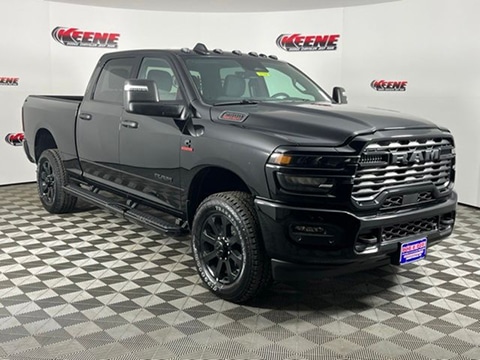
Choosing between diesel and gasoline is the first big decision any contractor, farmer, or fleet manager faces when shopping for a heavy-duty truck. The 2027 RAM 2500 Diesel vs Gasoline question comes up constantly at our Jarrettsville, Maryland showroom, and the honest answer depends on how you plan to use the truck. Before you decide, browse our RAM 2500 lineup to see current inventory of both configurations, then keep reading for the numbers that actually matter for your business.
2027 RAM 2500 Engine Lineup: Cummins Diesel vs. HEMI Gasoline
The 2027 RAM 2500 continues offering two proven powertrains: the 6.7L Cummins Turbo-Diesel and the 6.4L HEMI V8. Both pair with an 8-speed automatic transmission, though the specific transmissions differ by engine. A landscaping crew and a long-haul hauling operation need very different things from a truck, so knowing what each engine brings to the table matters before you sign anything.
6.7L Cummins Turbo-Diesel Specs
The Cummins High-Output produces 430 hp and 1,075 lb-ft of torque, paired with the TorqueFlite HD 8-speed transmission. That torque figure makes it the choice for anyone regularly pulling a loaded construction trailer up I-83 or across the rolling terrain around Jarrettsville, Maryland. Diesel torque arrives early and stays flat, which matters more than horsepower when you're moving heavy weight from a stop.
6.4L HEMI V8 Gasoline Specs
The 6.4L HEMI V8 delivers 405 hp and 429 lb-ft of torque, running on regular 87-octane fuel through a TorqueFlite 8HP75-LCV 8-speed transmission. It's quieter in daily operation than the Cummins and doesn't ask for anything beyond a stop at a regular gas pump. For crews hauling equipment trailers a few times a month rather than every week, that simplicity carries real appeal.
Towing and Payload Capabilities by Engine
The numbers below, which Ram has published as preliminary 2027 specifications, show what you can actually put behind or on top of each truck, and for most buyers, this table is where the choice starts to click into place.
| Engine | Horsepower/Torque | Max Towing | Max Payload | Fuel Economy | Transmission |
|---|---|---|---|---|---|
| 6.7L Cummins Turbo-Diesel | 430 hp / 1,075 lb-ft | Up to 20,000 lbs | Up to 3,990 lbs | ~16 city / 21 hwy (est.) | TorqueFlite HD 8-speed |
| 6.4L HEMI V8 | 405 hp / 429 lb-ft | Up to 17,740 lbs | Up to 4,580 lbs | ~14 city / 18 hwy (est.) | TorqueFlite 8HP75-LCV 8-speed |
Max Towing Ratings and What Affects Them
Towing capacity isn't just about the engine. Axle ratio plays a role: a 4.10 ratio maximizes acceleration and towing capability, while a 3.73 ratio balances performance with slightly better unloaded highway fuel economy. GCWR (Gross Combined Weight Rating) sets the ceiling on truck-plus-trailer weight, so confirm this figure against your actual towing setup before committing to either engine.
Payload Differences Between Diesel and Gas
Payload comes down to a simple formula: GVWR (Gross Vehicle Weight Rating) minus curb weight. The HEMI is lighter than the Cummins, so it leaves more room under that ceiling for cargo. That's the whole reason the gas engine actually beats the diesel on max payload even though it trails on towing.
The available Payload Upgrade Package, offered on 6.4L HEMI V8 models, raises GVWR from 10,000 to 11,040 lbs and pushes max payload to 4,580 lbs. It's available on Tradesman, Big Horn, Lone Star, Laramie, Limited, and Limited Longhorn trims equipped with the HEMI V8, and adds a Ram 3500 frame, rear leaf springs, and an anti-spin differential. If you're loading dense materials or a heavy camper rather than pulling a trailer, this package changes the math considerably on HEMI V8 models.
Performance and Drivability for Work and Daily Driving
Day-to-day feel matters too, especially if the truck doubles as a daily driver between job sites.
Power Delivery, Engine Braking, and Grade Control
The Cummins delivers power in a broad, steady band that feels planted under load, particularly on grades. For slowing down with a heavy trailer, it can be paired with an available exhaust brake, since diesels generally lean on service brakes more than engine deceleration.
The HEMI uses MDS (Multi-Displacement System), shutting off cylinders when they're not needed to help efficiency during light-load cruising. Neither system requires the driver to do anything special, but it's worth knowing why each truck behaves the way it does going downhill with a load on.
Cold-Weather Starting and Operation
Cold starts used to be a real diesel drawback. Ram switched the Cummins from a grid heater to glow plugs starting with the 2025 model year, cutting cold-start time to roughly 3 seconds compared to 30-plus seconds previously. This improvement is expected to carry over for 2027, making winter mornings around Jarrettsville, Maryland far less of a concern than they once were. The HEMI, running on gasoline, has never had this issue and starts instantly regardless of temperature.
Fuel Use, Maintenance, and Ownership Costs
Fuel and upkeep costs add up fast on a work truck, so it pays to look past the sticker price.
Fuel Type, Efficiency, and DEF Requirements
On fuel economy, the Cummins earns roughly 16 mpg city and 21 mpg highway (unofficial estimates, since heavy-duty trucks are EPA-test exempt), against about 14 city and 18 highway for the HEMI. Diesel also holds its efficiency better under towing load, while gas mileage drops noticeably once you hitch up a trailer.
The trade-off is DEF, or Diesel Exhaust Fluid, which the Cummins uses in its SCR (Selective Catalytic Reduction) system to reduce emissions. The tank holds 5.7 gallons and typically needs a refill every 5,000 to 7,000 miles, consuming roughly 1 gallon per 50 gallons of diesel burned. Diesel fuel itself usually costs 10 to 50 cents more per gallon than gasoline, so factor that into your per-mile math.
Both engines can be equipped with the standard 31-gallon tank or an optional 50-gallon tank, with some Cummins configurations approaching a 600-mile range.
Maintenance Needs and Long-Term Upkeep
The Cummins holds about 12 quarts of oil and needs fuel filter changes every 15,000 to 20,000 miles. The HEMI takes roughly 7 quarts and is simpler and cheaper to service overall. On longevity, many Cummins engines reach 400,000 miles with proper care, while HEMI engines typically run 200,000 to 300,000-plus miles with consistent oil changes and minimal idling. Neither figure is a guarantee, since real-world results vary with how the truck is driven and maintained.
Purchase Price and Value Considerations
We won't quote exact pricing here since 2027 figures aren't finalized, but the general pattern holds across generations: diesel carries a higher upfront cost due to the added DEF and SCR hardware, and it also tends to hold higher resale value. Heavy-use buyers often recoup that premium through resale value, towing efficiency, and reduced engine strain over the truck's life. Buyers who tow lightly or occasionally usually find better overall value in the HEMI's lower entry cost and simpler ownership experience.
Matching the Engine to Your Workload
The decision really comes down to matching the engine to what you actually do with the truck, not what sounds more impressive on paper.
Choose Diesel for Heavy Towing and Long-Haul Work
Weekly equipment trailers, long highway routes, or towing near max capacity on a regular basis, that's where the Cummins earns its premium. The torque, towing ceiling, and fuel efficiency under load make it the practical choice for that workload.
Choose Gasoline for Lighter Duty, Higher Payload, or Lower Upfront Cost
A fifth wheel three or four times a year, occasional equipment moves, or a need for maximum in-bed payload with dense materials, the HEMI covers that ground well and costs less to buy and maintain.
Which Engine Fits Your Work Needs:
-
Weekly heavy towing or near-max trailer weight: Cummins diesel.
-
Occasional towing, a few times per year: HEMI gas is usually adequate.
-
Need for maximum in-bed payload capacity: HEMI with 6.4L V8, especially with the Payload Upgrade Package.
-
Long highway hauls where fuel efficiency under load matters most: Cummins diesel.
-
Lower purchase price and simpler maintenance schedule: HEMI gas.
-
Long-term resale value on a heavy-use fleet truck: Cummins diesel.
Explore RAM 2500 Trucks and Financing at Keene CDJR
Once you've got a sense of which engine fits your workload, the next step is seeing the trucks in person.
Browse New RAM 2500 and Commercial Truck Inventory
Our commercial division at Keene CDJR stocks both Cummins and HEMI-equipped 2027 RAM 2500 trucks, along with ProMaster vans and other work truck configurations. You can explore our RAM 2500 lineup online, but we'd also encourage a visit to Jarrettsville, Maryland so you can sit in both trucks and compare cab layouts, bed configurations, and GVWR packages side by side.
Financing, Trade-In, and Service Support
Our on-site financing department works with business owners across a range of credit profiles, and we can walk you through options tailored to a commercial purchase. If you're upgrading from an existing work truck, our trade-in program makes the transition straightforward. Once you're on the road, our Mopar-certified service center handles routine maintenance, diagnostics, and commercial fleet servicing alike. You can explore financing options anytime through our online portal.
Compare Both Engines in Person at Keene CDJR
Specs on a page only tell part of the story.
How We Help You Decide
Our commercial-vehicle team can help you configure the right engine, GVWR, and axle ratio combination for your specific application, whether that's a landscaping trailer, a construction fleet, or long-haul freight work. We also offer in-person side-by-side comparisons so you can feel the difference between Cummins torque and HEMI responsiveness before you decide.
Get in Touch
For the 2027 RAM 2500 Diesel vs Gasoline decision, nothing beats sitting in both trucks yourself. Contact our sales team at 410-983-6765 or stop by our Jarrettsville, Maryland dealership to compare both powertrains and find the RAM 2500 that actually fits how you work.