


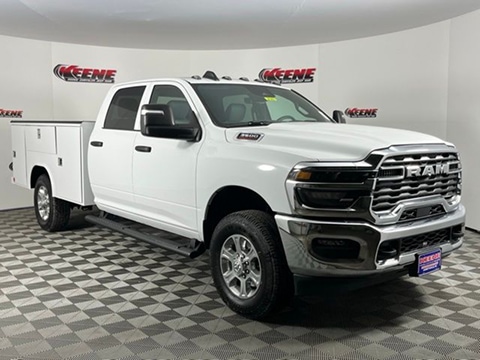
Contractors running Route 165 and Route 23 in a truck with 150,000 miles on it already know the math doesn't work forever. Section 179 tax deductions give business owners a way to replace aging vehicles and write off the cost the same year they buy, rather than depreciating it over half a decade. Landscaping crews and construction outfits across Harford County treat this as the kind of tax planning that shapes a purchase decision made before December 31. If you want to see what's on the lot while you plan, you can explore work-ready inventory at Keene CDJR in Jarrettsville.
This article is for informational purposes only and isn't tax or legal advice. Every business situation is different, so talk to a licensed CPA before making a purchase decision based on Section 179.
Section 179 Tax Deductions: A 2026 Opportunity for Jarrettsville Businesses
Section 179 tax deductions let a business deduct the full purchase price of qualifying vehicles and equipment in the year they're placed in service, instead of spreading the cost across several years of depreciation. For 2026, the deduction limit rises to $2,560,000, with the phase-out threshold starting at $4,090,000 in total qualifying purchases and the deduction disappearing entirely once spending hits $6,650,000. Most Jarrettsville small businesses will never come close to those ceilings, which is exactly why Section 179 tends to favor local operators over large fleets.
The deadline that actually matters for most readers is December 31, 2026. Vehicles have to be placed in service, meaning ready and available for business use, by that date for calendar-year taxpayers. Waiting until January pushes the deduction into the following tax year.
How Section 179 Works for Commercial Vehicle Purchases
Section 179 allows a business to treat a vehicle purchase as an immediate expense rather than a multi-year depreciation schedule, as long as the vehicle is used primarily for business. That single change in timing can matter a lot for a company deciding whether to buy a new truck this year or wait.
Combining Section 179 with 100% Bonus Depreciation
Bonus depreciation is a separate provision that lets a business deduct a percentage of an asset's cost beyond what Section 179 covers. For qualifying property both acquired and placed in service after January 19, 2025, bonus depreciation runs at 100%. The key difference from Section 179 is the income limit: Section 179 can't exceed your taxable business income, with any disallowed amount carrying forward indefinitely, while bonus depreciation has no such ceiling and can create a loss. Most businesses apply Section 179 first, then run bonus depreciation across what's left.
Key 2026 Limits: The $32,000 SUV Cap and Business-Income Rules
Heavy SUVs with a GVWR (Gross Vehicle Weight Rating, the maximum operating weight set by the manufacturer) between 6,001 and 14,000 pounds face a separate Section 179 cap of $32,000 for 2026, applied against the business-use portion of the vehicle's cost.
Three exceptions take a vehicle outside that cap: seating designed for more than nine passengers behind the driver's seat, a cargo area at least six feet in interior length that isn't readily accessible from the passenger compartment, or an integral enclosure fully enclosing the driver compartment and load-carrying device with no seating behind the driver. A vehicle meeting any one of those falls under the general Section 179 limit instead, not the $32,000 cap.
There's also a taxable-income limitation: Section 179 deductions can't exceed the business's taxable income for the year, though unused amounts can carry forward. This is where bonus depreciation's lack of an income ceiling becomes useful, and it's also where a CPA's input matters most.
Which Ram and Jeep Vehicles May Qualify
Vehicle eligibility comes down mostly to GVWR and how the vehicle is actually used in the business. Ram and Jeep offer several models that commercial buyers in Harford County frequently consider for this reason.
Ram Pickups: 1500, 2500, and 3500 Heavy Duty
The Ram 1500 carries a max GVWR of 6,900 to 7,200 pounds depending on configuration, so it clears the 6,000-pound threshold across the board. Here's where it gets interesting for tax planning: Ram offers the 1500 with a 6'4" box or a 5'7" box. The 6'4" bed clears the six-foot cargo-area exception, which takes the truck outside the $32,000 SUV cap. The 5'7" bed measures 67 inches, five inches short of the six-foot threshold, so it doesn't. Same truck, same GVWR, different treatment, which is why bed length belongs in the conversation before you sign.
| Model | GVWR | Section 179 Treatment |
|---|---|---|
| Ram 1500 | 6,900–7,200 lbs | 6'4" box clears the cargo-area exception; 5'7" box falls under the $32,000 cap |
| Ram 2500 | Class 2b (8,501–10,000 lbs) | Bed length clears the SUV cap |
| Ram 3500 Heavy Duty | Class 3 (10,001–14,000 lbs) | Bed length clears the SUV cap |
| Jeep Grand Cherokee | 6,050 lbs (2-row) | Heavy SUV; $32,000 cap applies |
| Ram ProMaster | Varies by configuration | Enclosure exception may apply; confirm the configuration |
Confirm GVWR on the certification label of the specific vehicle before relying on any figure here.
Qualifying SUVs: Grand Cherokee and GVWR Requirements
The Jeep Grand Cherokee carries a base two-row GVWR of 6,050 pounds, which puts it inside the heavy SUV category that triggers the $32,000 Section 179 cap. GVWR varies by trim and configuration, so a Grand Cherokee equipped one way may fall into a different weight bracket than the same model with different options. What matters at tax time is the number on the label, not the trim name on the window sticker.
Verifying GVWR on Your Vehicle's Certification Label
Every vehicle has a certification label, usually on the driver's door jamb, that lists its official GVWR. This is the number the IRS cares about, not the marketing spec sheet. Cab style and other configuration choices can shift a truck or SUV between light and heavy categories, so it's worth checking this label on the actual unit you're buying rather than assuming based on the model name. If you're weighing options, our team can walk through work-ready commercial vehicles with you and point out where to find this information on each vehicle.
Business Use Requirements and Eligibility Rules
Section 179 tax deductions hinge on one central rule: the vehicle has to be used for business more than half the time.
The 50% Business-Use Threshold
The IRS requires that a vehicle be used for business purposes more than 50% of the time, and the deduction itself is limited to that business-use percentage. If a truck is used 70% for the business and 30% personally, the deduction applies to 70% of the eligible cost. Keeping a mileage log or usage record isn't optional here; it's what substantiates the claim if the IRS ever asks.
It's also worth knowing that if business use drops to 50% or below in a later year, the IRS can recapture the excess depreciation already claimed. Seasonal businesses whose vehicle use patterns shift year to year face a real risk here, and a CPA conversation before finalizing a purchase can save a lot of headache later.
New and Used Vehicles: Both Can Qualify
Both new and used vehicles can qualify for Section 179, as long as the vehicle is new to your business, meaning you haven't owned or used it before. That opens the door for Jarrettsville business owners who want the tax benefit without buying brand new. Our used inventory includes work-ready Ram trucks and Jeep SUVs worth a look if a pre-owned vehicle fits your budget better.
Financing works fine, since Section 179 turns on whether you're treated as the owner for tax purposes and when the vehicle goes into service, not on how you paid for it. Leasing is different. Under a standard lease the leasing company owns the vehicle and takes the depreciation, so you generally can't claim Section 179 on it. Only leases structured as purchases, like a $1-buyout or conditional-sale arrangement, can qualify. Worth asking your CPA which structure you're actually signing.
Calculating Your Potential Tax Savings
The math behind Section 179 and bonus depreciation can get specific fast, so here's an illustrative walkthrough using placeholder figures, not actual pricing.
Say a Harford County landscaping company buys a heavy SUV for $90,000 and uses it entirely for business. The $32,000 SUV cap applies first, and 100% bonus depreciation can cover the remaining $58,000, for a combined first-year deduction of $90,000.
Business use changes the math. A $60,000 SUV used 60% for business produces a $36,000 business-use basis, which is still enough for the full $32,000 cap to apply, with bonus depreciation available on the $4,000 remainder.
Now compare that to a Ram 2500 with a full-length bed at the same $90,000. Because the six-foot cargo-area exception takes it outside the SUV cap, the entire amount can potentially run through Section 179 rather than being split between two provisions. Federally the first-year total can land in the same place either way, since bonus depreciation fills the gap on the capped SUV.
What the bed buys you is flexibility: Section 179 is elected asset by asset, so you control how much you take, subject to your taxable income, while bonus depreciation applies across a whole asset class. On the Maryland return, the bed makes little difference, since the state's own $25,000 Section 179 limit applies to both vehicles.
These are illustrations, not projections. Your actual deduction depends on purchase price, business-use percentage, and your business's taxable income for the year.
Common Mistakes To Avoid
-
Letting business use slip to 50% or below in a later year, which can trigger recapture of prior deductions.
-
Missing the December 31 placed-in-service deadline for the tax year you're claiming.
-
Assuming GVWR based on model name rather than checking the specific vehicle's certification label.
-
Skipping the mileage log. Vehicles are listed property, and the IRS expects records kept at or near the time of each trip.
-
Assuming the federal deduction carries over to your Maryland return.
What Maryland Does Differently
Here's the part that catches Harford County business owners off guard: Maryland doesn't follow the federal rules on either provision.
Maryland has been decoupled from federal bonus depreciation since 2002. For most businesses, including contractors and landscapers, any bonus depreciation you claim federally gets added back on the Maryland return, and depreciation is recalculated without it. Maryland also caps Section 179 at $25,000, reduced dollar-for-dollar above $200,000 in qualifying purchases, which are the pre-2003 federal figures. The adjustment goes on Form 500DM, filed with your Maryland return every year for the life of the asset.
Run that against the $90,000 SUV example. Federally, Section 179 plus bonus depreciation can cover the whole purchase in year one. On the Maryland return, you're looking at $25,000 of Section 179 and regular MACRS depreciation on the rest. The federal benefit is real, but it doesn't carry over, and the gap between the two returns is exactly the kind of thing worth modeling with your CPA before you commit to a December purchase.
Why Harford County Businesses Trust Keene CDJR
We've worked with contractors and fleet buyers all over Harford County long enough to know that tax timing questions come up as often as horsepower questions. A few things set us apart for commercial buyers.
Local Knowledge, Local Inventory
We keep a working inventory of Ram trucks, Grand Cherokees, and ProMaster vans that fit the profiles business owners are asking about this time of year, without the guesswork of a dealership unfamiliar with commercial weight classes.
On-Site Financing for Business Buyers
Our financing department works with customers across a range of credit profiles, which matters when a business is trying to place a vehicle in service before a specific deadline.
A Commercial Division That Understands Fleets
Our commercial division supports heavy-duty Ram fleet solutions and upfitting guidance, so the conversation doesn't stop at the sale. If you want a fuller picture of how we work with business owners, take a look at the Keene Advantage.
Beat the Year-End Deadline: Explore Eligible Inventory Today
Section 179 favors businesses that act before the calendar runs out. Whether you're working off Route 165, Route 23, or anywhere else in Harford County, the sequence is the same: check the GVWR label on the specific vehicle, confirm the bed length if you're looking at a 1500, run the numbers by your CPA, and see what's on the lot while there's still time to place it in service.
Talk to your tax professional about how Section 179 fits your situation, then browse our new and used Ram and Jeep inventory or contact our team at 410-983-6765 to talk through your options before the year-end deadline closes in.